
Who Speaks for You? A Simple Guide to Ohio Healthcare Power of Attorney
What Exactly is a Healthcare Power of Attorney?
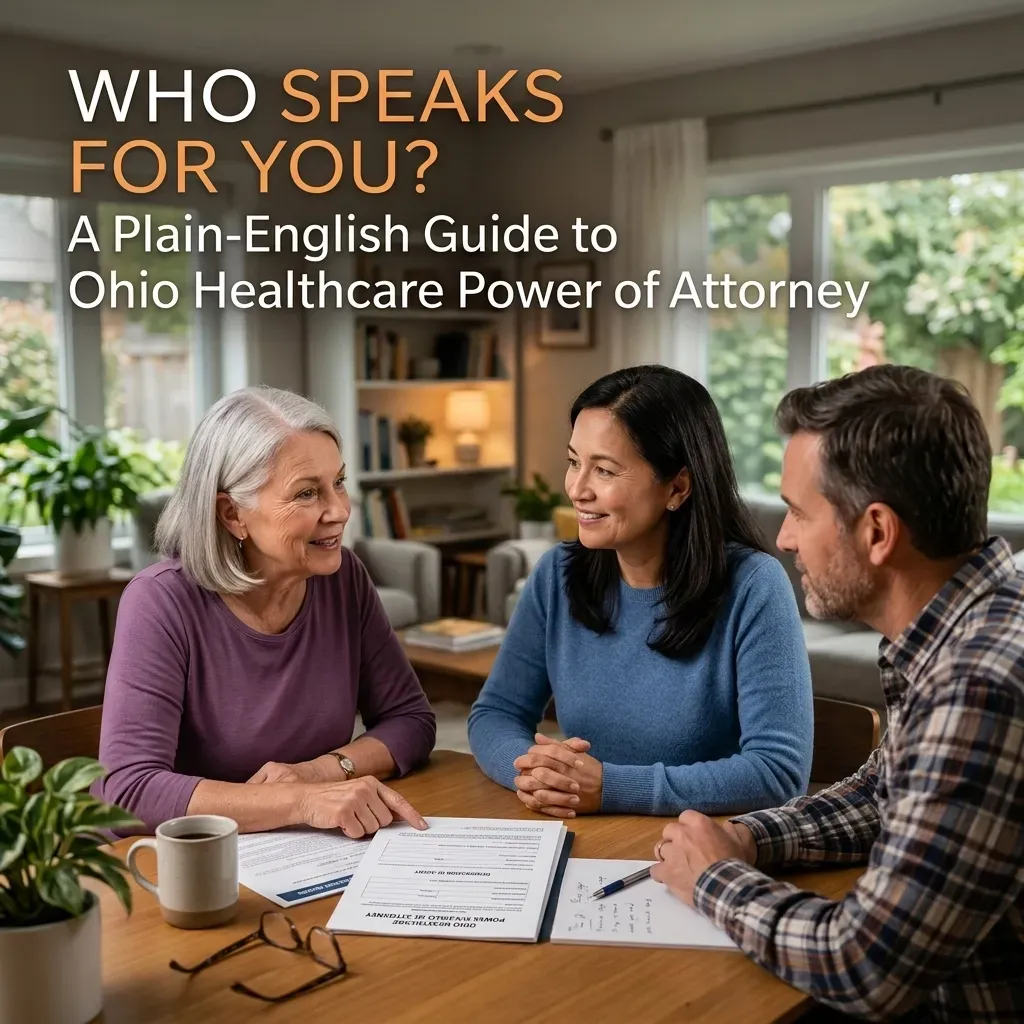
Life has a funny way of throwing curveballs when we least expect them. One minute you’re balancing a busy career, managing a household, or finally enjoying the quiet of retirement, and the next, an unexpected health event could leave you unable to communicate. If that happened today, who would stand by your hospital bed and tell the doctors what you want? Who would know your values well enough to make the "right" call? In Ohio, we have a specific way to handle this, and it’s called a Healthcare Power of Attorney (HCPOA). At the Law Offices of Laura Blumenstiel, we don’t just see this as a stack of legal papers. We see it as your "medical voice", a way to ensure your wishes are respected even if you can’t speak them yourself.
What Exactly is an Ohio Healthcare Power of Attorney?
At its core, an HCPOA is a legal document where you name a person you trust (your "agent") to make medical decisions for you if you become incapacitated. Think of it as choosing a teammate. This person isn’t there to do what they want; they are there to fight for the care you want. In our practice, we often talk about estate planning as a way to protect your money or your home. But an HCPOA is about protecting you, your body, your dignity, and your personal choices. It’s one of the most compassionate gifts you can give your family because it removes the guesswork and the guilt that often comes with medical crises.
1. It Only "Wakes Up" When You Need It
One common fear we hear from clients is, "If I sign this, am I giving away my right to make my own decisions?"
The answer is a loud and clear no.
In Ohio, your HCPOA document essentially stays "asleep" as long as you are conscious and capable of making your own choices. Your agent doesn’t get to override you just because they disagree with your choice of doctor or treatment. The document only "wakes up" if you unable to make or communicate your own healthcare choices. This could be because of a temporary situation, like being unconscious after an accident, or a long-term issue, like severe cognitive decline or dementia. The moment you regain the ability to speak for yourself, the agent’s power steps back into the shadows.
2. Your Agent’s "Superpowers"
When you name an agent in Ohio, you are giving them some pretty significant authority. We like to think of these as "superpowers" because they allow your agent to navigate the complex healthcare system on your behalf.
In Ohio, your agent can generally do almost anything you could do for yourself, including:
- Accessing Medical Records: They can jump through the HIPAA hoops to see your charts and talk to your specialists.
- Choosing Your Care Team: They can consent to or refuse specific surgeries, tests, and medications.
- Location of Care: They get to decide which hospital you go to or which nursing facility might be best for your recovery.
- Life-Sustaining Treatment: In many cases, they are the ones who will have the heavy conversation about things like feeding tubes or ventilators.
Because these powers are so broad, choosing the right person is vital. You want someone who is level-headed, comfortable talking to doctors, and, most importantly, willing to follow your instructions even if it’s emotionally difficult for them.
3. It’s Different from a Living Will (And Why That Matters)
This is where things get a bit "lawyerly," but it’s important to clear up the confusion. People often use these terms interchangeably, but in Ohio, they serve two different purposes.
- Healthcare POA: This names a person to make decisions in real-time for any medical situation.
- Living Will: This is a set of written instructions specifically for end-of-life care. It tells doctors directly what you want if you are in a terminal state or a permanently unconscious state (like, "I do not want a ventilator if there is no hope of recovery").
The Ohio Rule: If you have both documents and they seem to conflict, the Living Will usually takes precedence when it comes to end-of-life decisions.
4. Making it Legal in Ohio
You can’t just write "I pick my sister" on a napkin and call it a day. Ohio has specific rules to make sure these documents are valid and that nobody is being pressured into signing them.
To make your HCPOA legal in our state, you must sign it in the presence of:
- Two Adult Witnesses: These can’t be just anyone. They cannot be related to you by blood or marriage, they cannot be your designated agent, and they cannot be your attending physician or the administrator of a nursing home where you are receiving care.
- OR a Notary Public: This is often the easier route. A Notary confirms your identity and watches you sign, making the document official.
At our firm, we handle the probate and administration side of things too, so we know exactly how much trouble a "bad" or "missing" document can cause down the road. Getting the signatures right the first time is crucial.
Think of This as a "Gift of Clarity"
We see a lot of families in our office. Because we are a woman-owned firm, we often work with the "sandwich generation", women who are caring for their own children while also managing the care of aging parents. We see the stress in their eyes when a parent ends up in the ICU and there’s no HCPOA. Without this document, the family might have to go to probate court to ask for a "guardianship."
Guardianship is the "Plan B" you want to avoid. It is:
- Expensive: You have to pay court fees and an attorney.
- Slow: You’re at the mercy of the court’s calendar during a medical emergency.
- Public: Your private family business becomes a matter of public record. This is often particularly hard on the potential "ward", as they see a guardianship as an infringement on their dignity and freedom, and they are often embarassed.
By setting up a Healthcare Power of Attorney now, you keep the power in your family's hands. You take the burden off your daughter or your spouse. Instead of them standing in a hospital hallway arguing with a doctor or a sibling about what "Mom would have wanted," they can simply point to the document and say, "Here is the plan. Here is who speaks for her."
Special Considerations for Women and Caregivers
Caregiving is often a labor of love that falls on the women in the family. We know that moms and daughters are frequently the ones coordinating the appointments, tracking the meds, and holding the family together during a crisis. Of course, we often see men in this position as well. Having a Healthcare POA is a way to protect those caregivers. It gives them the legal "shield" they need to do their job. It’s much easier for a daughter to tell a persistent relative "I’m following the plan Mom laid out" than to have to justify her decisions based on a guess.
Whether you are looking into elder law for a parent or you're a young parent yourself wanting to make sure your spouse has the authority they need, this document is the foundation of a solid plan.
How to Get Started
Setting up an HCPOA doesn't have to be a cold, clinical process. It starts with a conversation.
- Pick your person. (And a back-up!)
- Talk to them. Make sure they are willing to take on the role and that they understand your values.
- Get it in writing. Work with a firm that understands Ohio law to ensure your document covers all the bases.
If you’re feeling overwhelmed, that’s okay. We are here to help. You can learn more about our team and how we approach these sensitive topics with the compassion they deserve.
Do you have a plan in place for who would speak for you? Or are you currently acting as a "voice" for a parent and realizing you need more formal authority? Whatever stage of life you’re in, we’d love to help you find that "gift of clarity."
Feel free to reach out to us to start the conversation. Let's make sure your voice is heard, no matter what the future holds.