The Dynamic Duo: How Ohio’s Living Will and Healthcare POA Work Together
Read On the See Why You Need Both
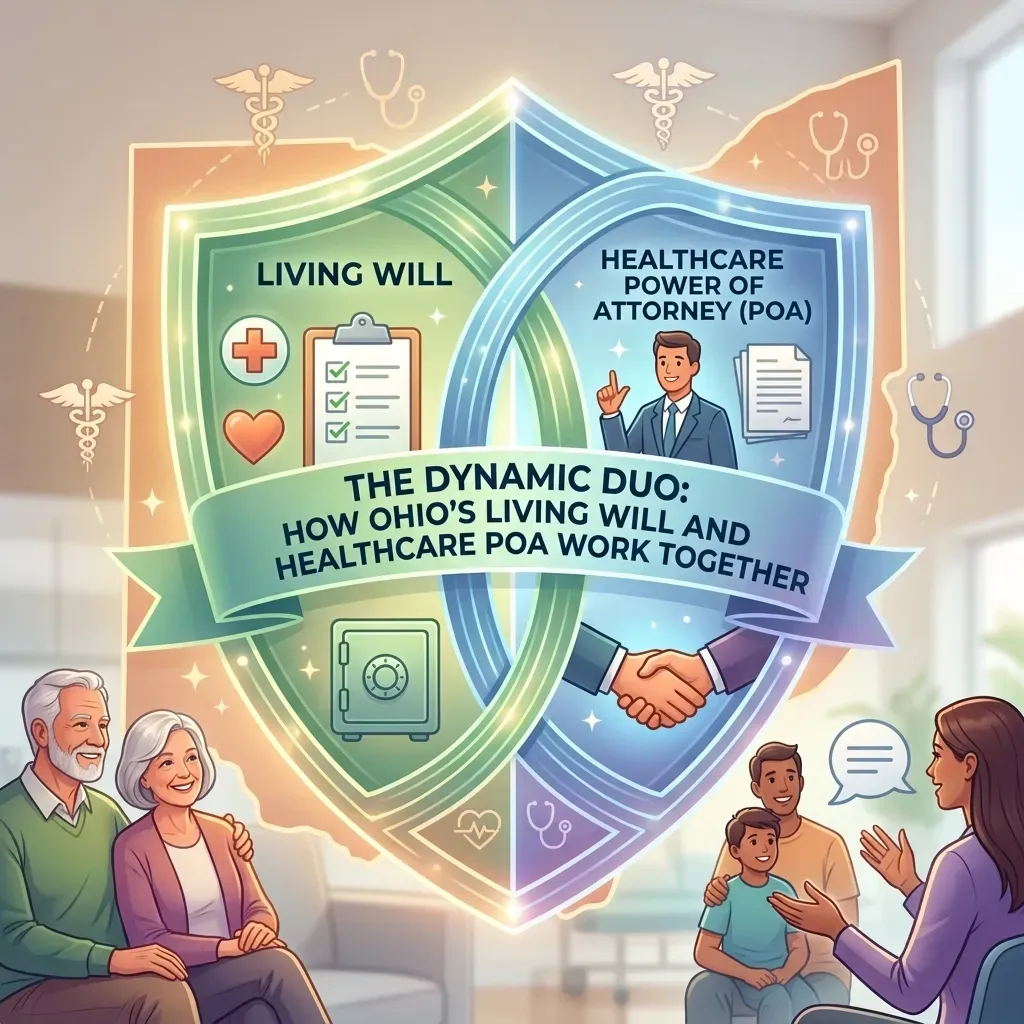
If you’ve ever sat down to think about your estate plan, you’ve probably come across a lot of confusing acronyms and legal terms. Two of the big ones that often get lumped together are the Living Will and the Healthcare Power of Attorney (HCPOA).
We hear it all the time: "Laura, do I really need both? Aren't they basically doing the same thing?" The short answer is: No, they aren't the same, and yes, you almost certainly need both. In Ohio, these two documents work together like a well-coordinated team. Think of them as the "Dynamic Duo" of medical planning.
When you have both in place, you aren't just filling out paperwork, you are giving a massive gift of clarity to your family.
Let’s break down how these two work, why they are different, and how Ohio law handles it when they need to work together.
The Living Will: Your "Playbook" for the End Zone
Think of your Living Will as your personal medical playbook. It is a written set of instructions directed primarily to your doctors and medical providers.
In Ohio, a Living Will doesn’t cover every medical situation. It specifically "wakes up" only in two very specific, very serious scenarios:
- You are in a terminal condition (meaning you have an incurable illness or injury and death is imminent).
- You are in a permanently unconscious state (like a vegetative coma with no higher brain function or the ability to experience pain or suffering).
The Living Will is where you state, in no uncertain terms, whether you want life-sustaining treatments, like ventilators, CPR, or artificial feeding tubes, if there is no hope for recovery. By writing these wishes down, you are taking the "guessing game" away from your family. Instead of your child or spouse having to agonize over whether to "pull the plug," they can point to the document and say, "This is what Mom wanted." It lifts the burden of the decision, and instead becomes a matter of respecting your wishes as expressed in your Living Will.
The Healthcare POA: Your "Quarterback" in the Field
While the Living Will is the playbook, the Healthcare Power of Attorney is your Quarterback.
A Healthcare POA (HCPOA) is a document where you name a specific person (your "agent") to make medical decisions for you if you become unable to speak for yourself. Unlike the Living Will, which is limited to end-of-life scenarios, the HCPOA is much broader.
Your agent can step in during situations that aren't necessarily "terminal." For example:
- You are in a car accident and are temporarily unconscious.
- You are undergoing a surgery and there’s an unexpected complication while you’re under anesthesia.
- You are experiencing advanced dementia or a stroke and can no longer understand medical options.
In these cases, your "Quarterback" (agent) looks at the situation in real-time, talks to the doctors, looks at your medical records, and makes the call based on what they know about your values. They can decide which hospital you stay in, which medications you take, and which surgeons perform your procedures.
How the Dynamic Duo Works Together
So, why do you need both?
Imagine a football game where there’s a playbook but no quarterback. If a play isn't exactly in the book, the team is lost. Now imagine a game with a quarterback but no playbook. The quarterback is under immense pressure to make every single decision from scratch without any guidance on the big goals.
By having both documents, you provide the "Full Circle" of protection:
- The HCPOA (The Quarterback) handles the day-to-day decisions and unexpected crises.
- The Living Will (The Playbook) provides the ultimate authority for the most difficult end-of-life decisions, ensuring the agent doesn't have to carry that specific emotional weight alone.
At our firm, we see how this reduces the emotional toll on families. It’s about more than just simple planning; it’s about protecting the emotional well-being of the people you love.
The Ohio Law Nuance: What Happens if They Conflict?
This is a question we get from our more detail-oriented clients: "What if my agent (my HCPOA) wants one thing, but my Living Will says another?"
Ohio law is very clear on this. Under Ohio Revised Code §2133.03(B), if you have both a Living Will and a Healthcare POA, the Living Will takes precedence regarding decisions about life-sustaining treatment if you are in a terminal condition or a permanently unconscious state.
Basically, your written "Playbook" overrides the "Quarterback" when it comes to those specific end-of-life choices. Why? Because the law assumes that your direct, written instruction is the most accurate reflection of your wishes. However, for everything else, surgeries, medication changes, choosing a nursing facility, or managing your medical records, your HCPOA agent is the one in charge. This is why it is so important that these two documents are drafted to complement each other rather than fight each other.
Why We Focus on Compassion (and Caregivers)
Many people (myself included) are "sandwiched" between caring for our children and caring for our aging parents. We know that when a medical crisis hits, it is usually your loved ones who end up in the hospital waiting room making the calls. Having these documents is one of the most compassionate things you can do for the people in your life. It prevents family infighting. It prevents your siblings from arguing in the hallway about "what Dad would have wanted." Without these documents, your family might have to go through the probate process to get a guardianship over you just to make medical decisions. That is expensive, slow, emotionally difficult for the ward, and very public. A well-drafted "Dynamic Duo" keeps these private decisions where they belong: within your family.
Making it Legal in Ohio
You can't just tell your family what you want and expect it to hold up in a hospital setting. To be valid in Ohio, these documents must be:
- In writing.
- Signed by you (while you are of sound mind).
- Witnessed by two qualified adults OR acknowledged by a Notary Public.
There are also specific rules about who can be a witness (for example, your agent cannot be your witness, and your doctor cannot be your witness). This is why working with an estate planning expert is so important. We make sure the "i's" are dotted and the "t's" are crossed so that your documents are ironclad when you need them most.
Is Your "Team" Ready?
If you only have one of these documents, or if you have neither, you are leaving your family's future to chance. At the Law Offices of Laura Blumenstiel, we pride ourselves on making this process feel less like a "legal chore" and more like a conversation about your life and your values.
Whether you are looking to set these up for yourself, or you are a caregiver trying to help a parent get their affairs in order, we are here to help. We can guide you through the nuances of elder law and ensure that your Dynamic Duo is ready for whatever life throws your way.
Don't leave your family guessing. Contact us today to start the conversation. From planning to probate, we're with you.
Disclaimer: This blog post is for informational purposes only and does not constitute legal advice. For specific legal guidance regarding your estate plan, please consult with a licensed attorney in your jurisdiction.